What Is a Battery Management System? BMS Functions Explained
A battery management system often stays invisible until something goes wrong. A device may shut down prematurely, or a battery pack may fail to charge. A customer reports heat, swelling or unstable runtime. In many lithium battery projects, the cells are only part of the answer.
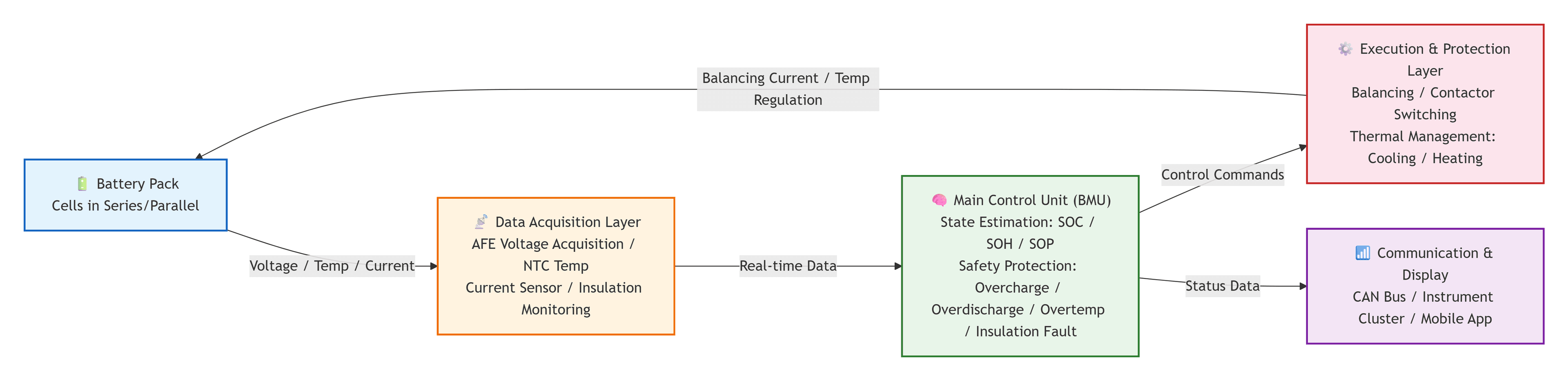
The battery management system, or BMS, helps the pack work inside safe electrical and thermal limits. It monitors voltage, current and temperature, then stops charging or discharging when conditions move outside the design range.
For OEM teams, the real question is not just "Does this pack have a BMS?" It is whether the BMS fits the product, cell chemistry, charger, load profile and user environment.
What Is a Battery Management System?
A battery management system is the electronic control layer that monitors and protects a rechargeable battery pack.
In a lithium-ion or lithium polymer pack, the BMS usually tracks cell voltage, pack current, temperature and protection thresholds. In multi-cell packs, it may also support balancing, communication and fault reporting.
The cells store energy. The BMS decides when the pack should keep working, limit output, stop charging or disconnect from the load.
Rechargeable lithium cells have defined voltage and temperature limits. Overcharge, deep discharge, overcurrent, short circuit events and excess heat can damage cells or shorten pack life.
Why BMS Functions Matter in OEM Battery Packs
BMS functions affect safety, runtime, charging behavior and user experience.
For a finished product, the battery pack does not operate in a lab. It sits inside a housing and works with a charger, connector, PCB, firmware and load. It may face heat, cold, repeated charging or long storage.
For example, a handheld scanner may need stable discharge under short bursts. A beauty device may need compact size and controlled charging. A T-BOX or outdoor camera may need standby reliability. A consumer robot may draw changing current as motors start and stop.
EPT works across lithium polymer batteries, cylindrical lithium cells and NiMH battery packs, so BMS planning should start with chemistry and application. For compact lithium pack formats, review EPT's lithium polymer batteries, where protection design and space limits both matter.
Core Battery Management System Functions
A BMS is not one single feature. It is a group of monitoring and protection functions.
The exact design changes by voltage, cell count, chemistry, load current and product class. Most lithium battery packs still need several core functions.
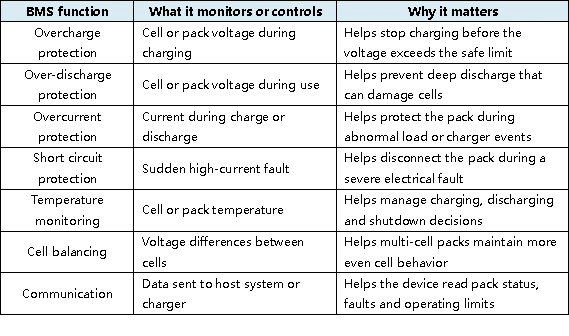
Not every product needs a complex smart BMS. A simple single-cell pack may use a protection circuit module, while a higher-voltage pack may need balancing and communication.
How a BMS Protects Against Overcharge and Over-Discharge
Voltage protection is one of the most important BMS functions.
During charging, lithium cells should not exceed their specified charge cutoff voltage. If the charger or control system fails, overcharge protection helps stop current before the pack moves into a damaging range.
During discharge, the opposite problem can happen. If a device keeps pulling power after cell voltage falls too low, deep discharge may reduce capacity.
A BMS watches these voltage limits and can disconnect charge or discharge paths when needed. In product design, these thresholds should match the selected cell and pack configuration.
Battery gauge behavior matters here. A product may shut down because the BMS protects the cells, even while the user thinks runtime remains.
Current, Short Circuit and Temperature Protection
A BMS helps protect the pack when current or temperature moves outside the intended range.
Overcurrent can happen when a motor starts, a device stalls, a connector fails or the wrong charger is used. The BMS should allow normal current peaks while reacting to abnormal current.
If the protection threshold is too low, the product may shut down during normal use. If it is too high, the cells and circuit may face unnecessary stress.
Short circuit protection addresses more severe fault conditions. The exact design depends on the battery pack, protection components and system architecture.
Temperature protection adds another layer. Charging lithium cells at unsuitable temperatures can damage the pack. For vehicles, outdoor cameras, tools or personal care devices, thermal testing should be part of validation.
Cell Balancing and Communication in Smart BMS Design
Cell balancing matters when a pack uses cells in series.
In a multi-cell pack, small differences between cells can grow over time. One cell may reach its upper or lower voltage limit before the others, causing early protection or reduced usable capacity.
A BMS can use balancing to keep series cells closer in voltage. This supports more predictable pack behavior.
Communication is another design choice. Some packs only need basic protection. Others need the host product to read state of charge, temperature or fault status.
Communication adds cost, development time and integration work. If the product does not need active data exchange, a simpler design may be enough.
How to Choose the Right BMS for Your Battery Pack
The right BMS starts with the device, not the circuit board.
Before selecting a BMS, define the pack and product requirements:
l Cell chemistry and cell count
l Nominal voltage and charge cutoff voltage
l Continuous and peak discharge current
l Charging method and charger type
l Operating temperature range
l Space for PCB, wires, connector and insulation
l Required protection functions
l Need for balancing, communication or state of charge (SOC) gauging
l Certification and compliance targets
If your pack uses cylindrical lithium cells, the BMS must match the voltage, current and layout needs of that format. EPT's cylindrical lithium battery and cell category is a useful reference for common cylindrical lithium projects.
For compact devices, PCB layout may be just as important as protection functions. A BMS that works electrically may still fail if it does not fit the housing or connector path.
Common BMS Mistakes to Avoid
Many BMS problems start before mass production.
The first mistake is treating BMS selection as a final accessory. If pack voltage, current, charging method and housing are already locked, the BMS may have too little room to solve design problems.
The second mistake is testing only under easy conditions. A pack may pass a basic test, then fail under peak current, heat, cold or long standby.
The third mistake is ignoring user behavior. A product may sit unused for months, charge with a third-party adapter or operate until cutoff.
The fourth mistake is overbuilding. A smart BMS can help some devices. For others, it adds complexity without improving user experience.